<-Back to WTN Archives
Hugh Richardson (TG)
World Tibet Network News
Monday, January 8, 2001
|
3. Hugh Richardson (TG)
The Guardian (London)
January 5, 2001
Our Last Man In Lhasa, He Brought Unrivalled Knowledge Of Tibet To Warnings
Of
Chinese Ambitions
On August 15 1947, the British mission to Lhasa pulled down the Union Jack
and hoisted the Indian national flag as the new republic inherited the raj's
diplomatic ties. At a stroke, Hugh Richardson, who has died aged 94, became
Britain's last representative to an independent Tibet and the first from
India.
But while the mission continued seamlessly with the same staff, the world of
central Asian politics was changing fast, something that Richardson, the
finest
Tibetan scholar of his era, pointed out in dispatches to both his British
and
Indian masters.
We ignored Tibet," said India's prime minister Jawaharlal Nehru, but the
Chinese did not. If the new republic failed to understand the threat on its
northern border, Richardson could see China coming. He left Tibet for good
in
1950, a few months before the Chinese overran Lhasa. He was called a vicious
aggressor" by Chinese propagandists, though, in truth, few men were less
vicious
or aggressive.
In fact, Richardson's greatest threat to the Chinese was his objective
observation of the labyrinthine world of Tibetan politics and his deep
understanding of Tibetan culture. When he argued that Tibet had been an
independent state before its occupation by the Chinese, he did so with
immense
authority.
An army officer's son, he was born at St Andrews, Fife. His elder brother,
Frank, followed their father into the military, also as a doctor, while Hugh
won
a scholarship to Keble College, Oxford, to read greats, the subject chosen
by
his predecessors in Tibet, Sir Charles Bell and Sir Basil Gould, both great
Tibet- ologists whom Richardson would eventually surpass.
After briefly teaching at his old school, Trinity College at Glenalmond,
Richardson sat the Indian civil service exam. He learned to speak Bengali
fluently, a skill that later helped him to befriend the Bengali poet
Rabindranath Tagore. His first posting, to Tamluk, in modern Bangla- desh,
also
drew on his Bengali skills, and from there he crossed the border from Sikkim
into Tibet, travelling as far as Phari in 1933 with his Tibetan servant
Pema.
But it was during his next posting, to Baluchistan, that Richardson's
interest in Tibet blossomed. Left with almost nothing to do, he indulged his
passion for gardening and got to know his colleague Basil Gould, the former
agent in Sikkim who, in 1936, recruited Richardson as his protege to join a
new
mission to Lhasa. The pretext was to mediate for the return from exile in
China
of the Panchen Lama, but Gould was determined to counter increasing Chinese
influence by establishing a permanent British presence. This he achieved,
leaving Richardson in charge when he left.
Richardson spent eight of the next 15 years in Tibet, from 1936 to 1940,
when he ret- urned to India for the remainder of the war, and from 1946 to
1950,
latterly for the Indian government. He learned to speak Tibetan fluently,
his
accent described by the Tibetan politician Tsipon Shakabpa as impeccable
Lhasa
Tibetan with a slight Oxford accent'. He witnessed astonishing times in
Lhasa,
including the arrival of the 14th (and current) Dalai Lama in 1936, and the
unwelcome expedition of 1939, led by Ernst Schaefer, which had been
dispatched
by Himmler to prove the Tib- etans were a lost Aryan race.
Such intrusions did not, however, dispel the magic of the place. A party at
Lhasa," Richardson later recalled, could last from 10 in the morning to 10
at
night and could go on for two days." He made his own contributions to the
fun,
introducing golf - the thin air being useful for long drives - and soccer.
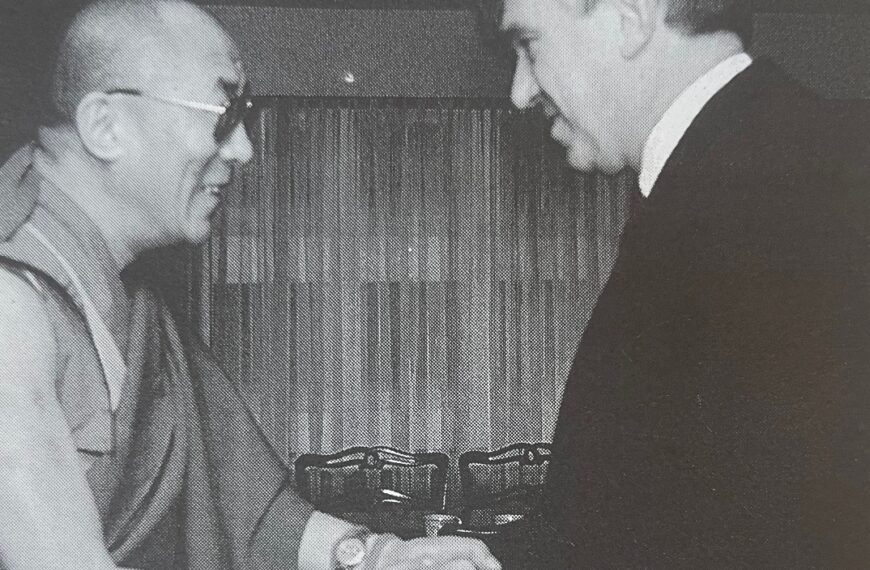
Although he missed the Dalai Lama's installation, Richardson kept in touch
with the Tibetan leader after the war - through the Austrian mountaineers,
Heinrich Harrer and Peter Aufschnaiter, when protocol prevented private
interviews, and, after 1959, more personally during the Dalai Lama's
continuing
exile. He continued to lobby the United Nations to oppose the Chinese
invasion
and described himself ashamed' when the British abstained.
After leaving Tibet, he returned to St Andrews, where he remained until his
death, a cherished member of the Royal and Ancient. He began a second career
as
a scholar on Tibetan culture and politics, and wrote prodigiously, co-
authoring
a cultural history of the country with David Snellgrove and writing papers
and
monographs, expertly collected by the Himalayan scholar Michael Aris in 1998
as
High Peaks, Pure Earth. Subjects range from the origins of the Tibetan state
to
early Tib- etan law on dog bites, something anyone who has travelled in
Tibet
will appreciate.
Richardson's work, encapsulated in this book, fills important gaps in the
historical record, as well as bearing witness to a culture that has been
systematically dest- royed over the last 50 years. At the time of his
memorial
service in St Andrews, monks lit butter lamps in the Jok- hang in Lhasa, and
the
Dalai Lama sent a personal message praising Richardson as an honorary
Tibetan'.
In 1951, Richardson married Huldah Rennie, whose first husband had been
killed during the war, and became stepfather to her children, David and
Elizabeth. She predeceased him in 1995.
Ed Douglas
Hugh Edward Richardson, diplomat and author, born December 22 1905; died
December 3 2000
Articles in this Issue:
- Dream of freedom fades for boy Buddha (DT)
- Healing the ancient way (TH)
- Hugh Richardson (TG)
Other articles this month -
WTN Index -
Mail the WTN-Editors