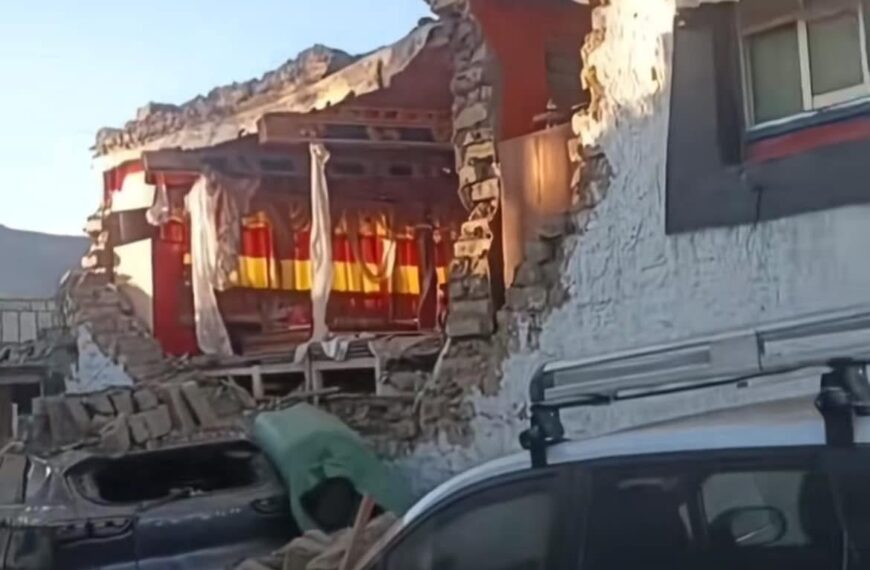
"Since mining started farmland has been destroyed and damage to grassland, trees, livestock and wild animals is immeasurable. We are just ordinary citizens, we could not know that the establishment of mining factories would bring about such disastrous consequences. This year, they are building another, even bigger processing factory, when the people did not agree to have the factory built, the township government forced us to give our consent…” - Tibetan villager protesting Gyama mine in Southern Tibet
Demonstrate and inform in support of Tibetan people's right to voice in relation to the exploitation and extraction of natural resources in Tibet.
Time: 8:00 a.m. to 12 noon (both days) (Conference: 8:00 a.m. - 6:00 p.m.)
Location: New Vancouver Convention Centre, 1055 Canada Place, Vancouver
Action: Distribute informational fliers (informing mining investors of the issues)
Background:
Eight Canadian companies are actively mining in Tibetan regions or are poised to begin digging soon (Continental Minerals/Hunter Dickinson, Jinshan Gold Mines Inc., Inter-Citic Minerals Inc., Maxy Gold Corp, Silvercorp Metals Inc., Sterling Group Ventures Inc., Silk Road Resources Inc., and Eldorado Gold Corp.). Five of those companies have head offices in our own backyard here in Vancouver. The most egregious of the lot (and that's saying something), Jinshan Gold Mines Inc., will have a booth at the conference.
Please join us to support Tibetan opposition to these mines and to learn more about this critical issue, as Canadian firms work with the Chinese government to unjustly extract minerals from the occupied lands of Tibetans.
We are concerned about all mining activities in Tibetan regions, because under the current climate of fear Tibetans have no opportunity for free, prior, and informed consent, and receive little if any benefit from these operations.
For more information on the issues, refer to:
Current crisis in Tibet:
- 17 May 2010, Radio Free Asia reports that thousands of villagers in Markham (Chinese: Mangkang) County of Chamdo Prefecture, Tibet Autonomous Region (TAR), defied a strong presence of People’s Armed Police Force (PAPF) to renew their protest against the resumption of Chinese mining on their sacred mountains, leading to at least five of them, including two women, being injured. They were reported to have tried to block the Chinese from resuming mining activities in the sacred area.
- The Tibet Government in Exile (TGIE) has clearly come out against mining on the Tibetan Plateau. As recently as October 2009 representatives of the TGIE issued a statement against mining in Tibet in general and against Continental Mineral's Shethongon in particular. The TGIE reasons that the mine which is located just a few kilometres from Central Asia's great water source, the Yarlung Tsangpo River (Brahmaputra River), poses a danger to the region's already fragile ecosystem. Chemicals used for the mine could ultimately leach into the river. http://www.tibet.ca/en/ctamining061009.
For many Tibetans, mining disrespects the sanctity of the land and spirits on the Tibetan Plateau.
- On 20 June 2009, Tibetans in Gyama, a beautiful area near Lhasa, clashed with Chinese miners and military police, critically injuring 3 Tibetans. The protest was about the diverting of water to service the copper mine in the upper Gyama region. To divert the water, pipes were laid across traditional farm land used to grow barley, but which was forcefully taken away from farmers without any compensation. A year before, toxic waste was dumped into the Gyama Shingchu River causing the death of the farmer's cattle. The Tibetan farmers demanded an immediate halt to the water diversion work and to all mining activities in the region. Jinshan Gold Mine Inc., essentially a Chinese mining company headquartered in Vancouver, recently purchased this mine from China National Gold, a Chinese state-owned enterprise and China's largest Gold producer. It still owns 41% of Jinshan's shares. http://blog.studentsforafreetibet.org/2009/12/tibets-water-pollution-and-chinas-global-warming-by-woeser/
- On 24 May 2009, residents of Tawu and Nyagchu County (Karze Tibet Autonomous Prefecture, Sichuan Province) gathered at the local county headquarters to protest the planned forced-relocation of tens of thousands of Tibetans to make room for the construction of a hydroelectric dam. Tibetan Centre for Human Rights and Democracy reported that Chinese troops fired indiscriminately into the crowd of protestors, and six Tibetan women were seriously wounded. Their current condition is unknown.
These protests are a clear indication of the Tibetan people’s opposition to the exploitation of their natural resources without their free, prior and informed consent – an international right that has been denied to them under China’s violent military occupation.
Tibetans who dare to protest mining projects do so knowing that they risk arrest, imprisonment, torture, and death. Following the Chinese government's crackdown during 2008's overwhelmingly peaceful protests in Tibet, thousands of Tibetans have been imprisoned or disappeared. Tibet remains a conflict zone, with armed forces patrolling towns and monasteries, foreign journalists continue to be denied access to Tibetan areas, and even NGOs which have provided aid and health care to ordinary Tibetans and Chinese for decades have been expelled.
In its May 19, 2009 News Release, Continental Minerals stated "the Xietongmen project can bring long- term benefits to the region." However, the Tibetan people have no say in the use of their land, and mining in this context poses a serious threat to the survival of the people, their culture, and the environment.
Please show your support
Protest dates: Sunday & Monday, June 6 & 7